People are where diffusion falls apart
Stable Diffusion renders scenes well and people badly: extra limbs, unresolved hands, poses that do not close. Conditioning methods such as ControlNet fix this if you hand the model a pose or depth map, but for text-to-image generation you do not have one, which is the entire difficulty. The alternative, classifier guidance, needs a segmentation model retrained on noisy latents, and naively decoding intermediate samples to apply a pixel-space loss means storing roughly a terabyte of computation graph.
Moving the supervision into the loss
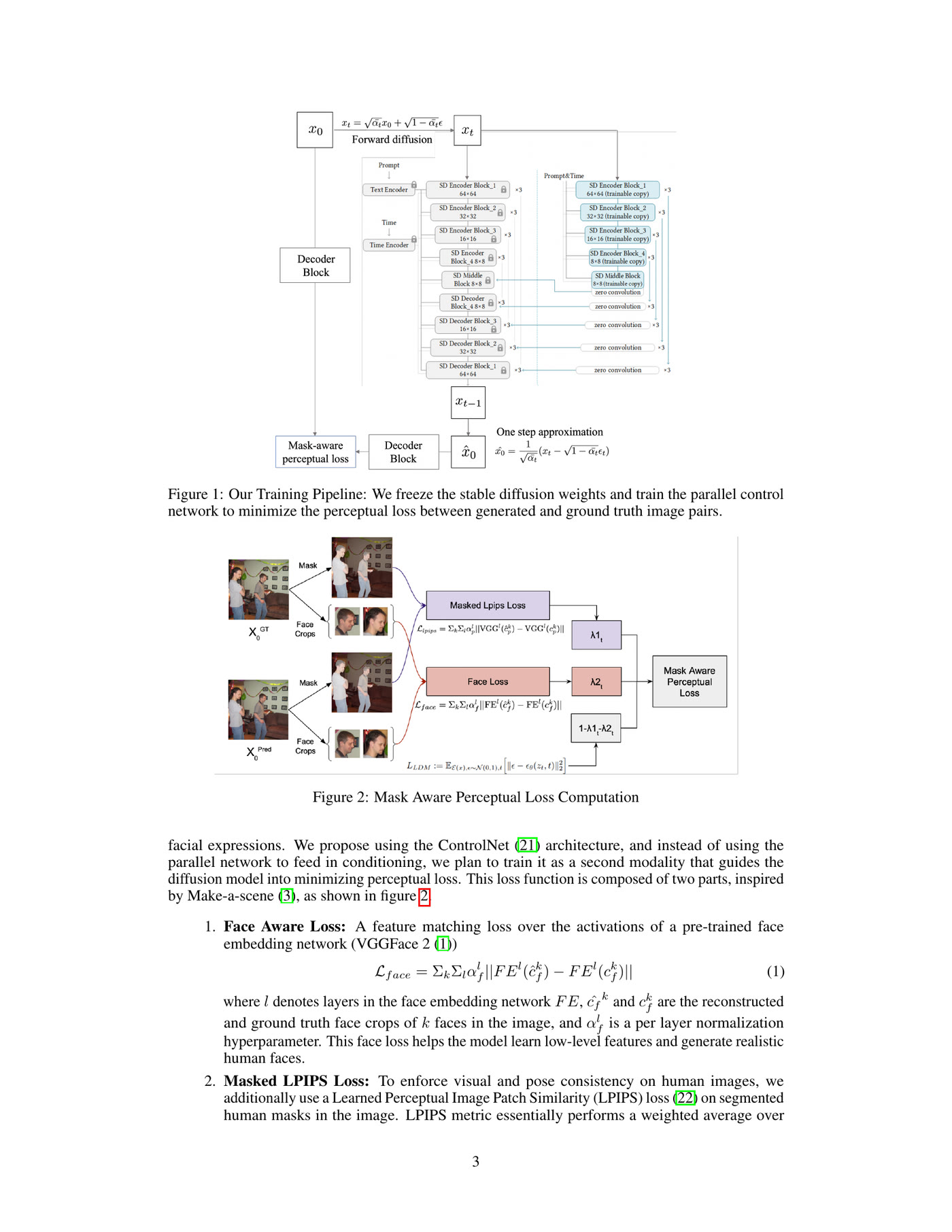
- A mask-aware perceptual loss with two terms: a masked LPIPS loss computed on VGG feature maps restricted to human segmentation masks, and a face term matching VGGFace2 activations on face crops. Combined with the standard LDM objective as a weighted sum.
- Applied the loss in pixel space to the one-step estimate of the clean image rather than DDIM-sampling back to t=0, which is what makes the memory cost tractable. Ground-truth masks and boxes transfer directly to the one-step image because the two are close below moderate noise levels.
- Trained the ControlNet parallel branch on a frozen Stable Diffusion 1.5 backbone, but used it as a loss-guided second modality rather than a conditioning input, so nothing extra is needed at generation time.
- Data: an MS COCO subset with heavy human coverage, 37,470 train and 1,565 validation images, at 512x512, batch size 1, 12 epochs on an RTX 3090.
- Ablated the loss timestep threshold T and both loss weights; best settings were T=100, lambda_1=0.2, lambda_2=0.5.
Masked LDM at T=100 scored 61.72 FID against 62.32 for Stable Diffusion and 63.95 for the retrained ControlNet baseline, computed on 500 images.
What the one-step estimate unlocked
- The one-step approximation is the enabling trick. Below roughly t=200 it is close enough to the clean image that pretrained VGG, VGGFace2 and the ground-truth masks apply directly, which sidesteps retraining any model on noisy inputs.
- The two hyperparameters do different jobs, and separating them mattered: the loss weights control what the model attends to, while T controls smoothness. At T=400 faces and poses improved but outputs went waxy, because one-step predictions at high noise are blurry. T=100 kept low-level detail.
- Retraining the ControlNet branch with no change to the loss produced no visible improvement. That negative control is what justifies attributing the gain to the loss rather than to the extra capacity.