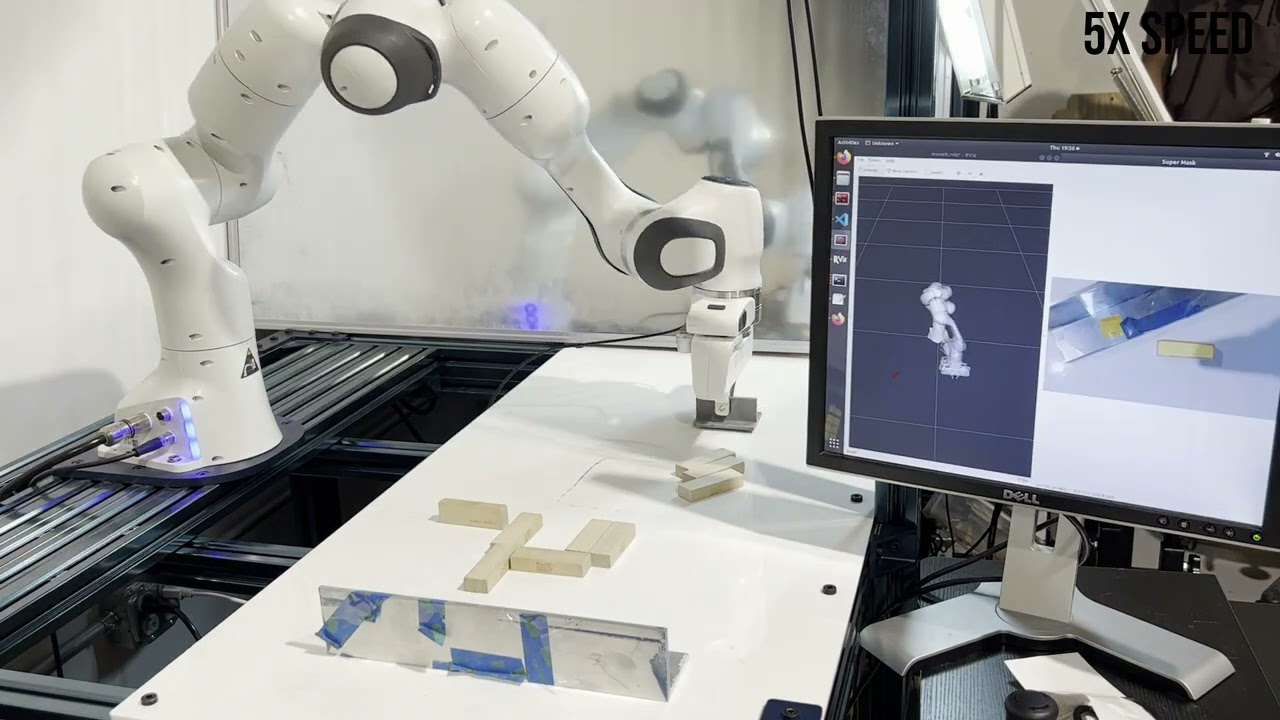
Stacking works until a grasp slips
Stacking looks like solved pick and place right up until a grasp slips. Jenga blocks are near-identical, they lie in a pile at arbitrary orientations, and a single bad pickup either drops a block or topples what is already built. The hard part is not the nominal pipeline; it is that the nominal pipeline has no notion of its own failure, so every error compounds into the next placement.
Perception, grasping, and a way back
- A finite state machine coordinating perception, planning and execution on a Franka Panda through frankapy, with MoveIt for motion planning.
- YOLOv8 instance segmentation on a wrist-mounted RealSense, trained on a custom Jenga block dataset. Hand-eye calibration through easy_handeye with ArUco markers.
- A heuristic grasp scorer that rejects poor candidates and picks a viable block out of the pile rather than reaching for the nearest one.
- Explicit recovery behavior: a failed or slipped grasp is detected, the arm backs off and retries from a known pose instead of continuing with a bad state.
- A compaction step after each placement that presses the block flush against the layer below, removing the accumulated misalignment that topples towers late in a build.
84% pickup accuracy across runs, with heuristic grasp selection accounting for most of the margin over nearest-block picking. The system ran two full tower-building rounds, resetting and rebuilding without intervention.
Why recovery beat precision
- Segmentation rather than bounding-box detection. An instance mask gives the block's in-plane orientation directly, so the wrist angle for the grasp comes out of perception instead of needing a separate pose estimation stage.
- Making failure a state in the machine rather than an exception. Once retrying is a normal transition, one bad grasp costs a few seconds instead of the tower.
- The compaction press is trivial to implement and disproportionately useful. Millimeter errors that individually look harmless are what make the fifth layer fall over.