No tarmac, no contrast, and the paint keeps vanishing
Lane detection methods assume a highway: high-contrast paint on dark tarmac, roughly straight, consistently lit. IGVC provides the opposite. Hand-painted lines on a grass field under moving sun, no consistent lane structure, and frequent gaps where the paint has worn away. Every assumption the standard pipeline rests on fails simultaneously, and the result still has to run at frame rate on the vehicle's onboard compute.
Geometry instead of learning
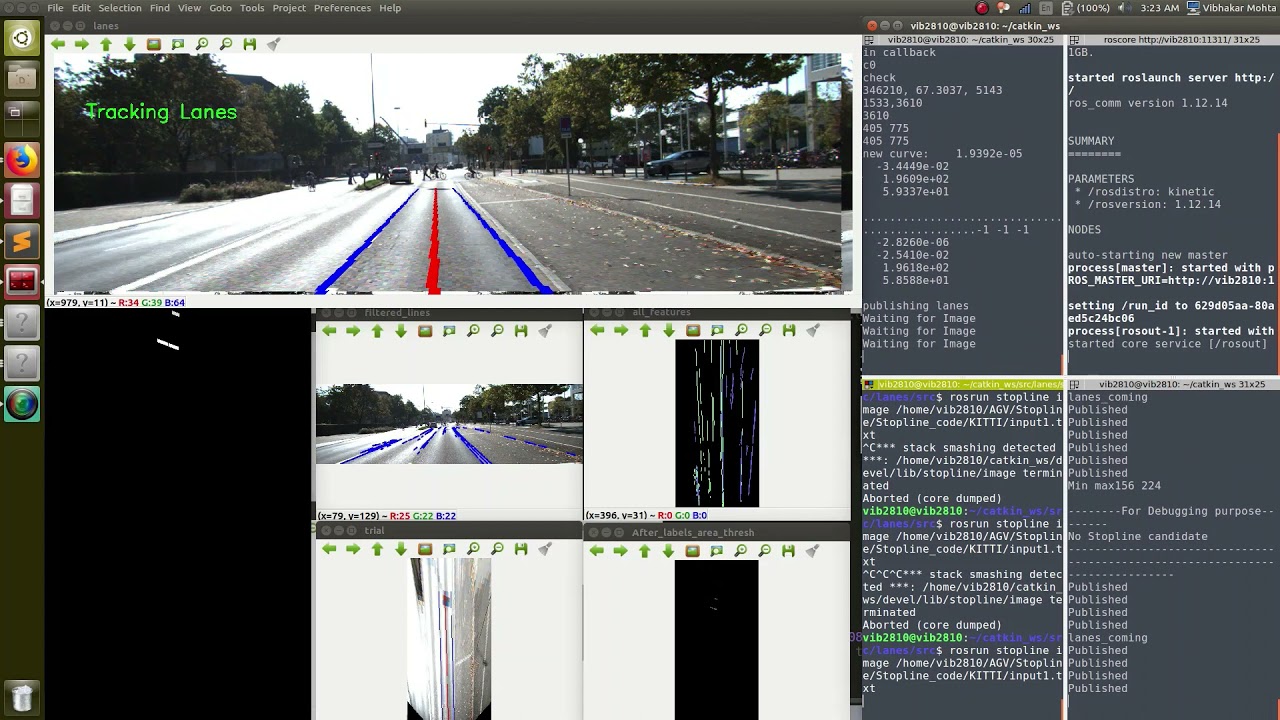
- Perspective transformation into a bird's-eye view, so lane geometry becomes metric and roughly parallel instead of projective and converging.
- Principal component analysis with lateral clustering over candidate lane pixels, fitting lane curves and separating stop lines from lane markings by their orientation.
- An unscented Kalman filter tracking the fitted lane parameters across frames, carrying the estimate through gaps and detection dropouts.
- Integrated as the perception front end of the EKLAVYA IGVC autonomy stack, feeding the vehicle's navigation.
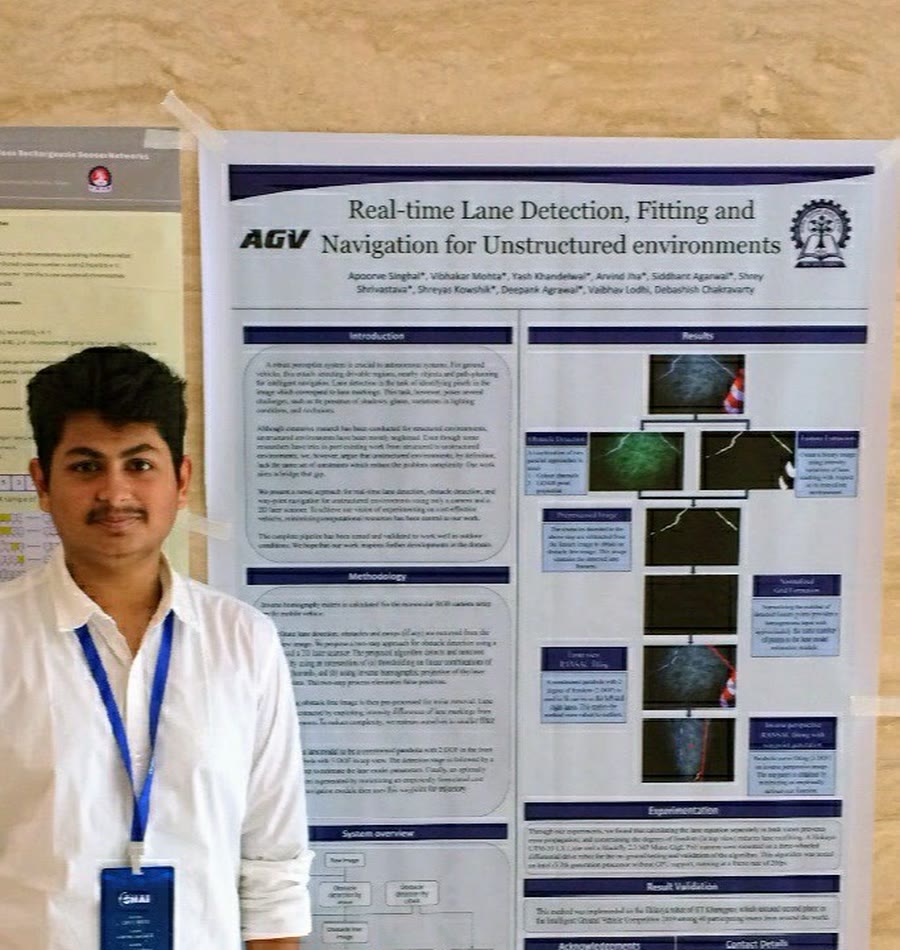
The method was published at IVPAI 2019 (SPIE) and ran at frame rate on the vehicle's onboard compute as the perception front end of the EKLAVYA IGVC stack. It recovers lane curves and stop lines from hand-painted markings on grass, separating the two by orientation alone with no classifier, and holds the estimate through the frames where the paint disappears.
What carried the estimate through the gaps
- The bird's-eye transform is what makes PCA usable. After it, a lane segment's principal axis lies roughly along the driving direction and a stop line's lies across it, so the two separate on geometry alone with no classifier involved.
- The UKF absorbed exactly the dropouts that faded paint and grass produce. Per-frame detection was too intermittent to steer on; the tracked estimate was not.
- Fitting geometry rather than learning it kept the whole thing inside the vehicle's compute budget and independent of any labeled dataset from that particular field, which matters when the field changes every competition.